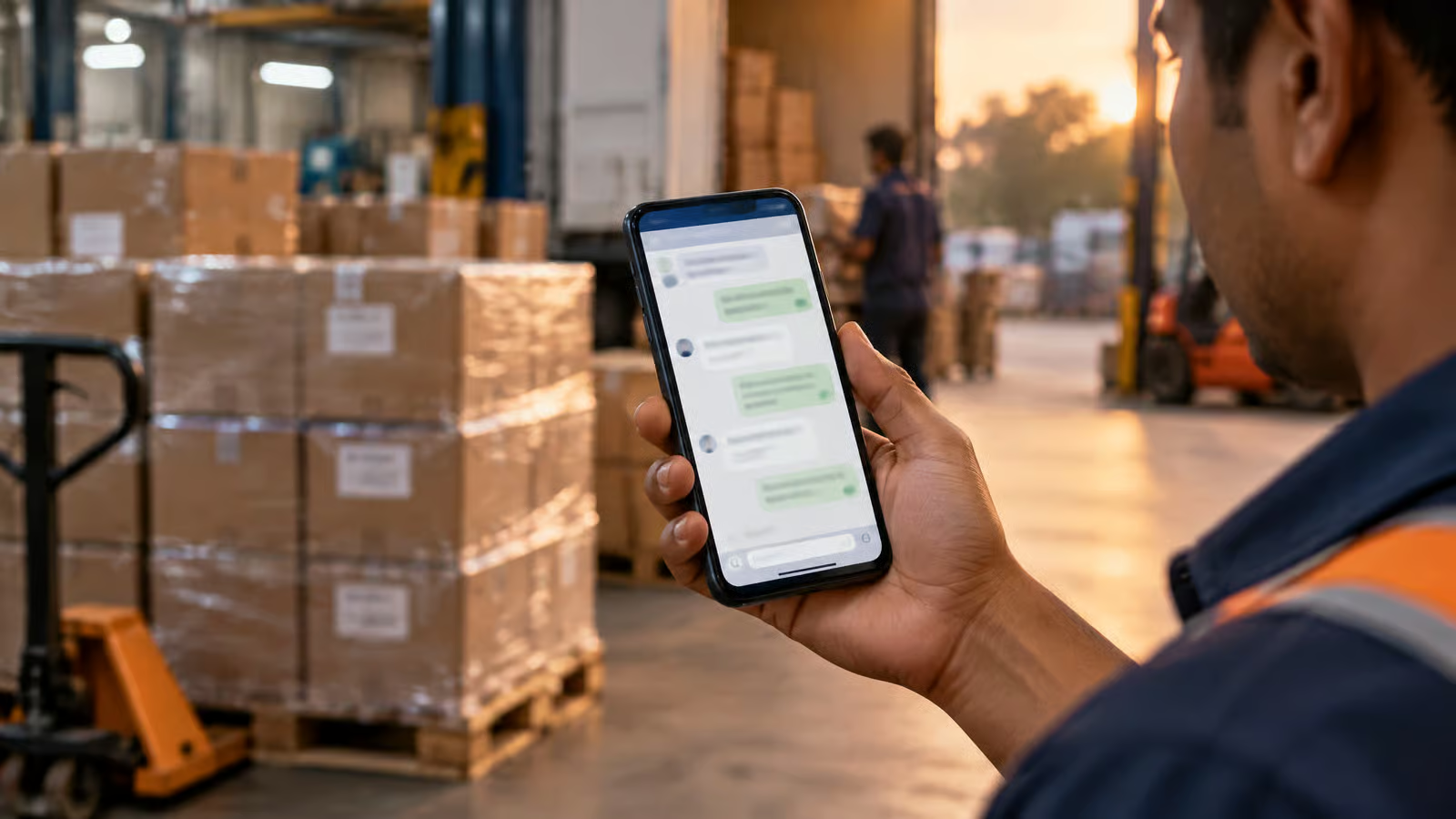
AI for B2B sales in manufacturing captures every enquiry from email, WhatsApp, marketplaces and your website, scores it by fit and value, and makes sure every lead and quotation is followed up on time. It drafts follow-up messages, records win and loss reasons and flags regular customers who have gone quiet. Your sales team still owns the relationship.
Why do B2B manufacturing leads slip through the cracks?
Leads slip through the cracks because they arrive in too many places and follow-up depends on one person's memory. In a typical factory:
- Enquiries arrive on the owner's WhatsApp, a salesperson's phone, a marketplace app, the general email inbox and by phone.
- There is no single list of every enquiry and its status.
- Salespeople travel, so follow-ups wait until they are back in the office.
- When a salesperson leaves, their leads and customer history leave with them.
- Nobody records why a quotation was lost, so the same mistakes repeat.
What is lead management in B2B manufacturing?
Lead management is the process of capturing every enquiry, tracking it through quotation and negotiation, and recording the result. The list of all open leads and their stages is called the sales pipeline.
Stage | What happens | Key action |
|---|---|---|
Enquiry received | A buyer asks about a part, product or job | Log it the same day |
Qualified | You confirm it fits what you make | Check capability, quantity and timeline |
Quotation sent | A priced offer goes to the buyer | Set follow-up dates |
Negotiation | Price, delivery or specification discussed | Record changes and decisions |
Won or lost | The buyer decides | Record the reason |
Repeat | The customer orders again | Watch for gaps in ordering |
How does AI help with lead management?
AI helps by doing the repeated work at each stage: capturing, sorting, reminding and recording. The main tasks it takes over are:
- Capturing every enquiry from email, WhatsApp, website forms and marketplace notifications into one register.
- Extracting the details: company, contact, item, quantity, material and required date.
- Checking history: whether this company has bought before, what they paid and how quickly they paid.
- Routing: sending each lead to the right salesperson or estimator.
- Drafting the first reply: an acknowledgement with a date for the quotation, for a person to approve.
- Reminding: alerting the salesperson when a follow-up is due.
For factories that prepare many quotations, Osvik's RFQ to quotation automation combines this with drafting the quotation itself, follow-up reminders and a weekly summary of quotations sent, won and lost.
How do you score and prioritise leads?
Score leads by how well they fit your factory and how valuable and urgent they are. A simple points system is enough to start, and AI can apply it to every enquiry automatically.
Factor | Points |
|---|---|
Matches your main processes and materials | 0 to 3 |
Order value or quantity | 0 to 3 |
Clear drawing and specifications provided | 0 to 2 |
Existing or past customer | 0 to 2 |
Required date is realistic for you | 0 to 2 |
Example: Enquiry A is from a new buyer for 50 pieces of a part you rarely make, with no drawing: 1 + 1 + 0 + 0 + 1 = 3 points. Enquiry B is from a past customer for 2,000 turned parts in your usual material, with a full drawing and a realistic date: 3 + 3 + 2 + 2 + 2 = 12 points. Enquiry B gets quoted first. The numbers are illustrative; set your own weights.
Scoring does not mean ignoring small enquiries. It means answering the best ones first when time is short, and replying to the rest with a clear date.
How does AI automate sales follow-ups?
AI automates follow-ups by tracking every quotation's date, drafting the right message at the right time, and stopping as soon as the buyer replies. A person approves the message or lets agreed templates go out automatically.
- Schedule: for example, day 3, day 7 and day 14 after the quotation.
- Draft: a short, polite message that refers to the quotation number and adds something useful, such as a confirmed lead time.
- Send: on email or WhatsApp, from your business name, after approval.
- Stop on reply: when the buyer responds, the follow-up stops and the salesperson takes over.
- Record: the reply and, eventually, the win or loss reason.
Example message: "Dear Mr Shah, following up on our quotation Q-2217 for 2,000 flanges sent on 12 March. We can confirm delivery within 3 weeks of your PO. Please let us know if you need any changes. Regards, Priya, Sharma Engineering."
WhatsApp follow-ups must go through the official WhatsApp Business Platform using approved templates, and only to contacts who have agreed to receive messages. Meta sets the message category and charges per message, as explained on its WhatsApp pricing page. Our WhatsApp integration is set up this way.
How can AI win back customers who have gone quiet?
AI can spot regular customers whose orders have slowed or stopped by comparing their recent orders with their usual pattern in Tally or your sales sheet. It then alerts the salesperson with a suggested reason to call.
Example: A customer who ordered every month for two years has not ordered in 75 days. AI flags it, shows the last order and last complaint, and suggests a check-in. Often the reason is simple: a new buyer at the customer, a price concern or a missed delivery that nobody followed up.
Winning back an existing customer is usually quicker than finding a new one. For more ways to grow repeat business, see our guide on how to get more orders for your manufacturing business.
Do small manufacturers need a CRM for sales follow-up?
Not necessarily. A CRM (customer relationship management software) helps, but many CRMs fail in small factories because salespeople do not have time to update them. What matters is one reliable register of leads and follow-ups.
That register can be a Google Sheet, Excel or a CRM such as Zoho CRM. AI can keep it updated from emails and WhatsApp, so nobody has to type every enquiry. See how this works with Excel and Google Sheets or Zoho.
What should stay with your sales team?
Relationships, negotiation and judgement stay with people. AI should not decide prices, promise delivery dates that production has not agreed, or handle a sensitive conversation after a quality complaint. It gives your salespeople the time and the information to do those things well.
When follow-up messages include personal contact details, handle them responsibly. India's DPDP framework, summarised in the government's DPDP Rules overview, expects businesses to use personal data only for the purpose it was shared for.
What should you measure?
Measure a few numbers every month to see whether lead management is improving:
Measure | What good looks like |
|---|---|
Time to first reply | Same working day |
Quotations followed up on schedule | Every one |
Win rate | Rising over time |
Loss reasons recorded | Every lost quotation |
Dormant customers contacted | Every flagged customer |
Start with one register
For the next two weeks, put every enquiry your factory receives into one sheet, with its source, date and status. The gaps you find, and the follow-ups that never happened, will show you exactly what to automate first.
If you want that register to fill itself and follow-ups to happen on time, book a free call. If a task repeats in your factory, tell us about it. To keep customers informed after they order, read our guide to WhatsApp chatbots for manufacturers.
Frequently asked questions
How is AI used in B2B sales?
In B2B sales, AI captures enquiries from email, WhatsApp and web forms, extracts the details, scores leads, drafts replies and follow-up messages, reminds salespeople when action is due, records win and loss reasons and flags customers whose orders have slowed. Salespeople approve messages and manage relationships.
What is lead scoring in manufacturing sales?
Lead scoring gives each enquiry points based on how well it fits your processes, its value, how complete the specifications are, whether it is from an existing customer and whether the timeline is realistic. It helps a small team quote the most promising enquiries first.
How do you follow up on a quotation?
Follow up on a fixed schedule, such as 3, 7 and 14 days after sending. Keep each message short, mention the quotation number and add something useful, like a confirmed lead time. Stop when the buyer replies, and always record why the quotation was won or lost.
Do small manufacturers need a CRM?
Not always. What matters is one reliable register of every lead, quotation and follow-up. A Google Sheet or Excel file can work if it is kept up to date. AI can update it from emails and WhatsApp, which solves the main reason CRMs fail in small factories.
Can AI send WhatsApp follow-ups automatically?
Yes, through the official WhatsApp Business Platform, using approved message templates and only to contacts who have agreed to receive business messages. Most factories have a person approve messages at first, then allow standard follow-ups to go out automatically once they trust the wording.
Will AI replace salespeople in manufacturing?
No. AI removes the typing, sorting and reminding around sales, so salespeople spend more time talking to buyers, visiting customers and solving technical questions. Relationships, negotiation and judgement remain with people, and are what win B2B orders.
Want this for your factory?
A free 30-minute call. Bring one real enquiry, sheet or report.