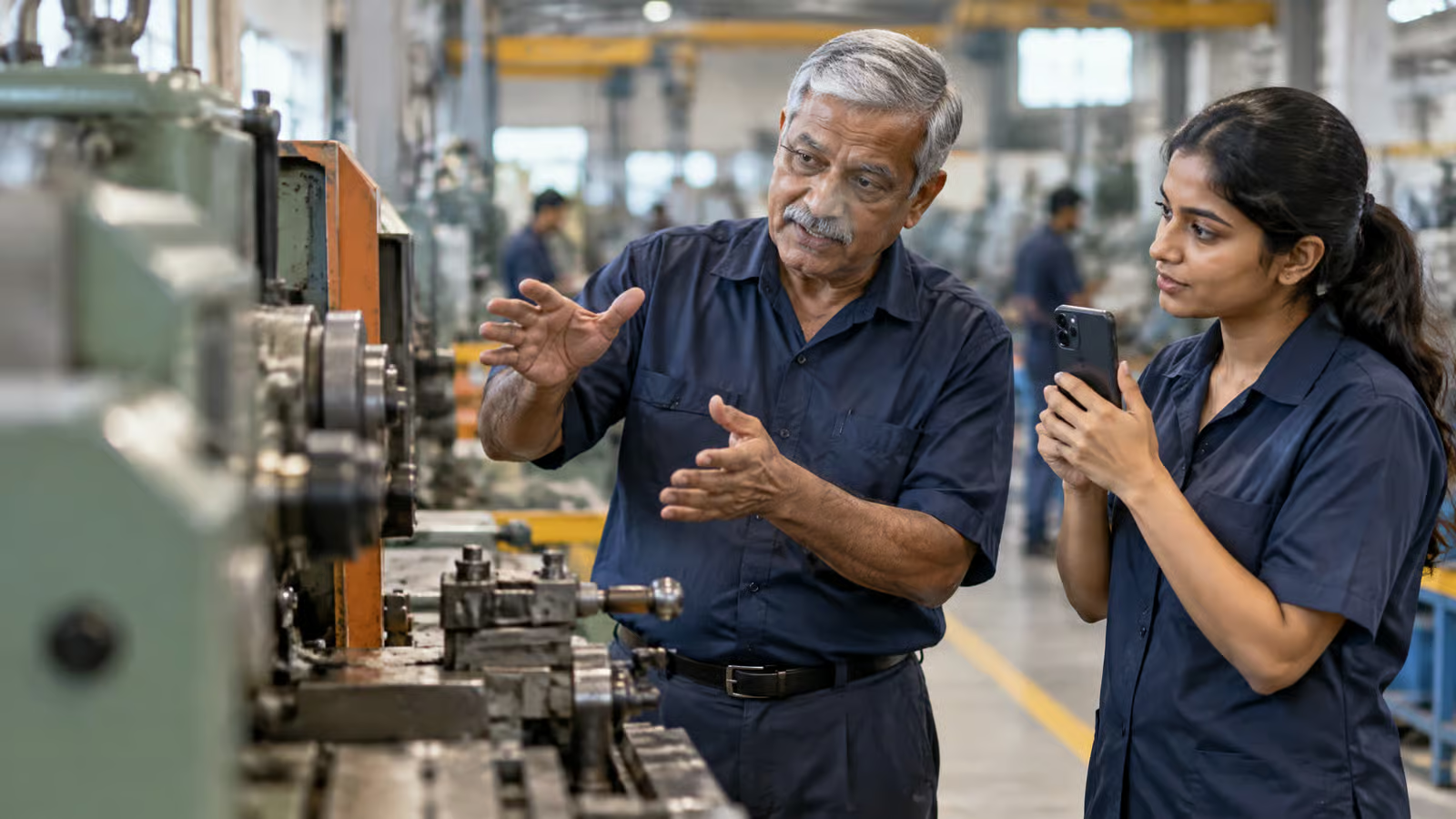
Operator training in manufacturing is faster when new operators learn from short videos of real tasks, clear step-by-step SOPs in their own language, a skill matrix that shows what they can do, and an AI assistant they can ask on the shop floor. Senior operators still coach, but they repeat themselves less, and every trainee learns the same method.
Why does operator training take so long?
Operator training takes long because the knowledge sits in a few senior people's heads, written SOPs are hard to use, and training happens in between production pressure. The usual problems are:
- Knowledge in people, not documents: only two senior operators know the tricks for a difficult setup.
- SOPs nobody reads: long, in English, out of date and kept in a file in the office.
- Training squeezed in: the trainer is also running a machine, so explanations are rushed.
- High attrition: new operators leave, and training starts again.
- Inconsistent methods: each trainer teaches their own way, so quality varies.
- No records: nobody knows who is trained on what until an auditor asks.
What should an operator training programme include?
A practical training programme for operators has six parts, from induction to regular refreshers.
Part | What it covers |
|---|---|
Induction and safety | Plant rules, personal protective equipment, emergency steps, machine guarding |
Job-specific SOPs | Step-by-step method for each task, with key quality points |
Supervised practice | Doing the task under a trainer until it is right every time |
Skill sign-off | A supervisor confirms the operator can do the task independently |
Skill matrix | A record of each operator's level on each task |
Refreshers | Retraining after a process change, a quality problem or a long gap |
How do video SOPs speed up training?
Video SOPs speed up training because a trainee can watch the correct method as many times as needed, at the machine, in their own language, without taking a senior operator away from work.
A good video SOP is short, from one to three minutes, and covers one task. It shows the best operator doing the job, with a voice explaining each step and the key quality checks. A QR code on the machine links straight to the right videos.
Example: Instead of one long setup document for a CNC job, the plant films five short clips: loading the fixture, setting the tool offsets, running the first piece, checking it with the gauge and starting the batch. A new operator watches the relevant clip before each step, and the trainer only steps in to check and answer questions.
How do you make video SOPs in your factory?
Make video SOPs with a phone, your best operators and a simple review step. No studio is needed.
- List your top ten tasks, starting with the ones that cause the most mistakes or take longest to teach.
- Film your best operator doing each task in normal conditions, with good light and clear sound.
- Keep one task per clip, from one to three minutes.
- Add the key points as short captions: critical dimensions, safety steps, quality checks.
- Review with the supervisor and quality head before using it.
- Store it with a version number and link it by QR code at the machine.
- Update it whenever the method changes, and retire the old version.
How can AI help train new operators?
AI can do much of the work around training: turning videos into written SOPs, translating them, answering trainees' questions and keeping training records up to date.
- Written SOPs from videos: AI transcribes the operator's explanation and drafts a step-by-step SOP for the supervisor to check.
- SOPs from voice notes: a senior operator describes a task in a WhatsApp voice note, and AI turns it into a structured draft.
- Translation: the same SOP in Hindi, Marathi, English or other languages your team uses.
- Answers on the floor: a trainee asks on WhatsApp, "What is the torque for the M10 bolt on fixture F-3?", and gets the answer from your own SOPs, with a link to the video.
- Short quizzes: a few questions after each video to check understanding.
- Training records: each sign-off is recorded, and supervisors get reminders when refreshers are due.
Osvik builds these as a custom AI solution, including an "ask your documents" assistant that answers from your own SOPs over our WhatsApp integration. For how AI reads and organises documents, see our guide to document AI.
What is a skill matrix?
A skill matrix is a simple table showing each operator's level on each task, so you can see at a glance who can run which machine and where training is needed.
Operator | CNC setup | CNC running | Gauge inspection | VMC running |
|---|---|---|---|---|
Ramesh | 4 | 4 | 3 | 3 |
Suresh | 2 | 3 | 3 | 1 |
Anil | 1 | 2 | 2 | 0 |
Levels here are 0 not trained, 1 learning, 2 can do with help, 3 independent and 4 can train others. The matrix helps you plan shifts, pick trainers and show auditors that operators are competent. The names and levels are illustrative.
What training records do auditors expect?
Auditors expect evidence that operators are competent for the work they do. ISO 9001 requires organisations to determine the competence people need, provide training where needed and keep documented evidence of competence. Automotive customers under IATF 16949 usually expect more, including on-the-job training records.
Keep training records, skill sign-offs and the skill matrix together, so they can be shown in minutes. Osvik's quality documentation and audit readiness solution keeps these records organised and reminds owners when refreshers are due.
How do you measure whether training is working?
Measure training by results on the shop floor, not by hours spent in training. Useful measures are:
- Days until a new operator works independently on a task
- First-pass yield, or rejection rate, for parts made by new operators
- Number of questions and errors in the first month
- How many new operators are still with you after three months
For longer-term skills, government programmes such as the Skill India Digital Hub offer courses you can combine with your own training.
Film your first three videos this week
Choose the three tasks new operators ask about most, film your best operator doing each one on a phone and play them to your next new joiner. You will see the difference in their first week.
If you want AI to turn your videos and voice notes into SOPs in every language your team speaks, book a free call. If a task repeats in your factory, tell us about it. For more on how AI changes factory roles, read will AI replace factory office staff?
Frequently asked questions
How long does it take to train a machine operator?
It depends on the machine, the complexity of the parts and the operator's experience. Simple loading and running tasks can be learned quickly, while setups on CNC machines take much longer. Short video SOPs, a skill matrix and clear sign-off criteria usually shorten the time for every task.
What is a video SOP?
A video SOP is a short video, usually one to three minutes, that shows the correct way to do one task, with spoken instructions and captions for key quality and safety points. Operators can watch it at the machine, often through a QR code, as many times as they need.
What is a skill matrix in manufacturing?
A skill matrix is a table showing each operator's skill level on each task or machine, from not trained to able to train others. It helps plan shifts, decide who needs training, choose trainers and show auditors that operators are competent.
Can AI help train factory workers?
Yes. AI can turn videos and voice notes into written SOPs, translate them into local languages, answer trainees' questions on WhatsApp from your own SOPs, run short quizzes and keep training records up to date. Experienced operators still coach, but they repeat themselves less.
How do you train operators who do not read English?
Use short videos with spoken explanations in their language, SOPs translated into Hindi, Marathi or other local languages, pictures for key steps and hands-on practice. Let operators ask questions by voice note, and check understanding through demonstration rather than written tests.
What training records does ISO 9001 require?
ISO 9001 requires you to determine the competence needed for work that affects quality, ensure people are competent through training or experience, take action where needed and keep documented information as evidence. Training records, sign-offs and a skill matrix together usually meet this.
Want this for your factory?
A free 30-minute call. Bring one real enquiry, sheet or report.