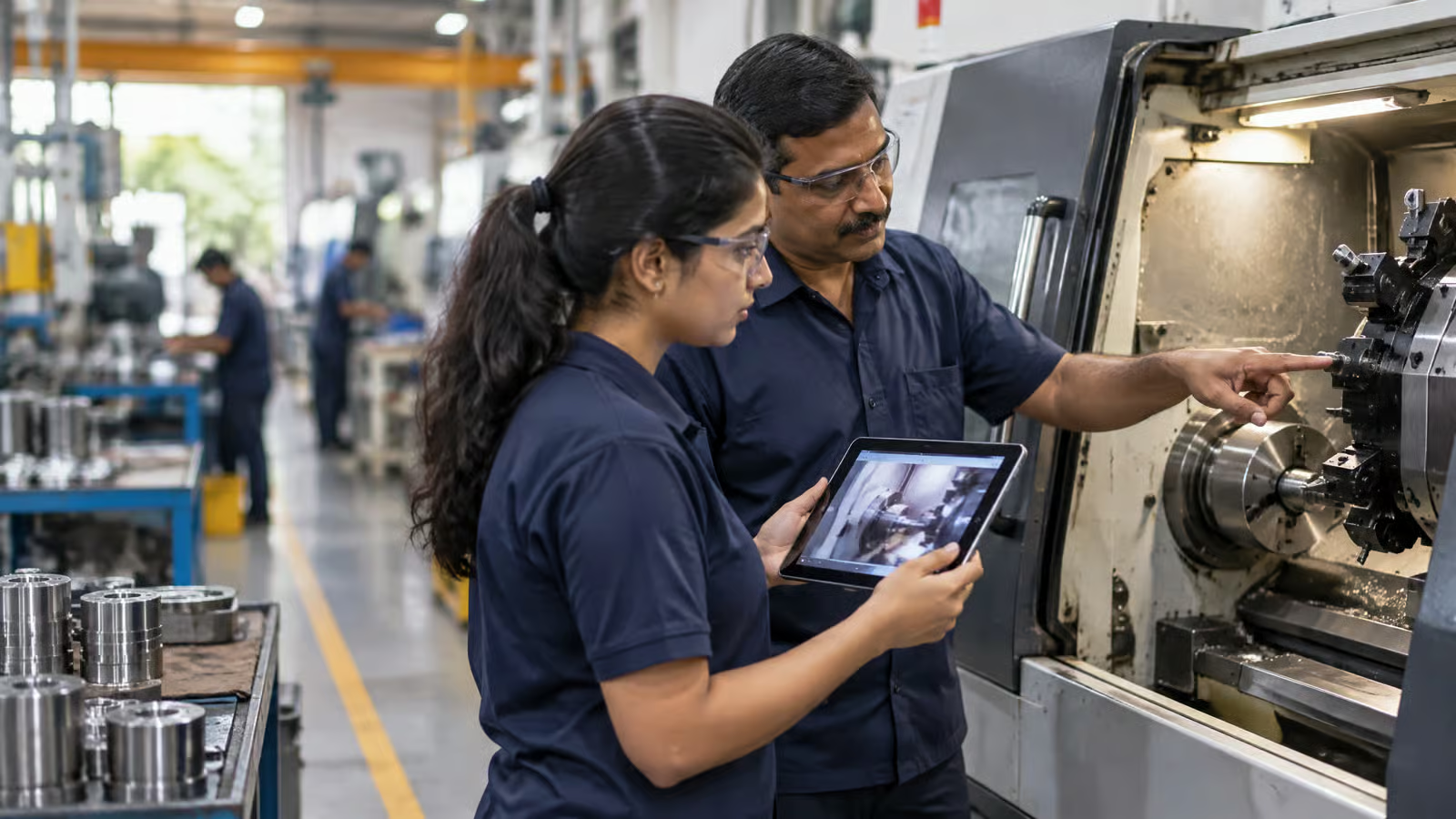
Knowledge management in manufacturing means capturing what experienced people know, such as setup tricks, costing logic, customer preferences and fixes for recurring problems, and storing it where others can find and use it. Start with the most critical knowledge, record it through interviews, videos and voice notes, and let an AI assistant answer questions from it.
Why is losing a senior employee so risky for a factory?
Losing a senior employee is risky because much of what keeps a factory running smoothly lives in a few people's heads, not in any system. When they leave, the problems show up slowly: quotes go wrong, setups take longer, old breakdowns come back and customers notice.
Consider a few familiar examples:
- The estimator who knows how to price a difficult part, including the extras the costing sheet misses.
- The maintenance fitter who knows exactly what to check when the old press starts vibrating.
- The accounts head who knows which customers pay after two reminders and which need a call from the owner.
- The supervisor who knows the settings that stop flash on one particular mould.
None of this is in a manual, and all of it took years to learn.
What knowledge should you capture first?
Capture first the knowledge that only one or two people have, that is used often and that causes real cost when it is missing. Score each area quickly to decide.
Knowledge area | Example | Risk if lost |
|---|---|---|
Costing and quoting | How to price complex or unusual parts | Loss-making quotes or lost orders |
Machine setup | Settings and tricks for difficult jobs | Longer setups, more rejections |
Maintenance | Early warning signs and fixes for old machines | Longer breakdowns |
Customer knowledge | Preferences, contacts, past complaints | Damaged relationships |
Supplier knowledge | Who is reliable, who needs chasing | Late material, higher prices |
Quality problem history | What caused past defects and what fixed them | Repeated problems |
What is the difference between explicit and tacit knowledge?
Explicit knowledge is already written down or easy to write, such as rate lists, drawings and procedures. Tacit knowledge is the experience and judgement people use without thinking about it, such as knowing from the sound that a tool is wearing out.
Explicit knowledge mainly needs organising. Tacit knowledge needs to be drawn out through conversation, observation and examples, which is why asking a senior person to "write it all down" rarely works.
How do you capture knowledge from experienced staff?
Capture knowledge through methods that fit how experienced people naturally explain things: talking, showing and solving real problems.
Method | How it works | Best for |
|---|---|---|
Structured interviews | A 30 to 45 minute conversation with prepared questions, recorded | Judgement, costing logic, customer knowledge |
Shadowing and video | Film the person doing the task while they explain | Setups, maintenance, inspection |
WhatsApp voice notes | The person records a short explanation whenever something comes up | Everyday tips and fixes |
Problem diaries | After each unusual problem, a short note on what happened and what fixed it | Maintenance and quality |
Reviewing past work | Go through old quotations, 8D reports and complaint files together | Pricing, quality history |
Pairing | A younger colleague works alongside for weeks or months | Complex roles |
Past quality reports are especially valuable. Our guide on how AI helps find the root cause of recurring quality problems shows how those records become useful again.
What questions should you ask in a knowledge interview?
Ask questions that bring out judgement and exceptions, not just the normal steps. These work well:
- What are the three most common mistakes a new person makes in your job?
- What do you check that is not written anywhere?
- Which customers, suppliers or machines need special handling, and why?
- Tell me about the hardest problem you solved in the last year. How did you know what to do?
- When do you ignore the standard procedure, and what do you do instead?
- What early signs tell you something is about to go wrong?
- Which numbers or rates do you keep in your head rather than in the system?
- If you were away for a month, what would go wrong first?
How can AI help capture and use knowledge?
AI makes knowledge capture faster and, more importantly, makes the captured knowledge easy to use. Without that, recordings and notes sit in a folder nobody opens.
- Transcribing interviews, videos and voice notes, in Hindi, Marathi, English or a mix.
- Drafting SOPs, checklists and FAQs from the transcripts, for the expert to review.
- Organising knowledge by machine, part, customer or supplier, so it can be found.
- Answering questions through an "ask your documents" assistant, such as "What was the last rate we quoted for part 4412?" or "What fixed the vibration on press 2 last year?", with a link to the source.
- Surfacing history from old quotations, 8D reports and emails when a similar situation comes up.
Osvik builds this as a custom AI solution, with the assistant available over our WhatsApp integration so people can ask from the shop floor. Pricing knowledge can also feed RFQ to quotation automation, so a senior estimator's rules are applied to every quote. For how AI reads older documents, see our guide to document AI.
What does a handover plan for a retiring employee look like?
A good handover plan starts months before the person leaves and ends only after the successor has handled real situations.
When | What to do |
|---|---|
Six months before | Agree what knowledge is critical and who will take it over |
Three to six months before | Run interviews, film key tasks, collect voice notes and review past work |
One to three months before | Successor does the work while the expert watches and corrects |
Last month | Review and approve all captured SOPs, FAQs and notes |
After leaving | Agree a way to contact the person for occasional questions, if they are willing |
If you train new operators too, our guide on training new operators faster with AI and video SOPs covers the other half of the process.
How do you make knowledge capture a habit?
Make knowledge capture part of normal work rather than a one-off project when someone resigns.
- Give it an owner, usually the plant head or quality head.
- Set a routine, such as one hour a month per senior person.
- Recognise contributors openly, so sharing knowledge is valued rather than seen as a threat.
- Add it to the exit process for everyone, not just senior staff.
- Review and update captured knowledge at least once a year.
This also supports audits. ISO 9001 expects organisations to determine and maintain the knowledge needed to run their processes, and captured, organised knowledge is good evidence of that. Our quality documentation and audit readiness solution keeps it organised. For formal skills development alongside this, the Skill India Digital Hub lists courses for industry staff.
Start with one person and one hour
Pick the one person whose absence would hurt most, book an hour with them and ask the eight questions above. Record it. That single conversation will show you how much knowledge is at risk, and how much of it you can save.
If you want that knowledge turned into an assistant your team can ask, book a free call. If a task repeats in your factory, tell us about it. For more on costing knowledge, see our guide on how to calculate product cost in manufacturing.
Frequently asked questions
What is knowledge management in manufacturing?
Knowledge management in manufacturing is capturing, organising and sharing what experienced people know, such as setup methods, costing logic, maintenance fixes, customer preferences and quality history, so the business does not depend on a few individuals and new staff can learn faster.
How do you capture knowledge from employees who are leaving?
Start months before they leave. Identify critical knowledge, run recorded interviews with prepared questions, film key tasks while they explain, collect voice notes and review past work together. Then let the successor do the work under their guidance before they go.
What is tacit knowledge in a factory?
Tacit knowledge is experience and judgement that people use without writing it down, such as recognising a worn tool by its sound, knowing which customer needs special handling or adjusting a setting for a particular material batch. It is best captured through conversation, observation and real examples.
How can AI help with knowledge management?
AI can transcribe interviews and voice notes, draft SOPs and FAQs, organise knowledge by machine, part or customer, and answer staff questions from your own documents through an assistant on WhatsApp or email, with links back to the original source.
Does ISO 9001 require knowledge management?
ISO 9001 expects organisations to determine the knowledge needed to operate their processes, maintain it and make it available as needed, and to consider how to gain additional knowledge. Captured procedures, lessons learned and problem histories are practical ways to show this.
How do you get senior staff to share what they know?
Explain why it matters, recognise their expertise openly and make sharing easy: conversations and voice notes rather than writing long documents. Many experienced people are glad to pass on what they know when they see it is valued and will be used.
Want this for your factory?
A free 30-minute call. Bring one real enquiry, sheet or report.