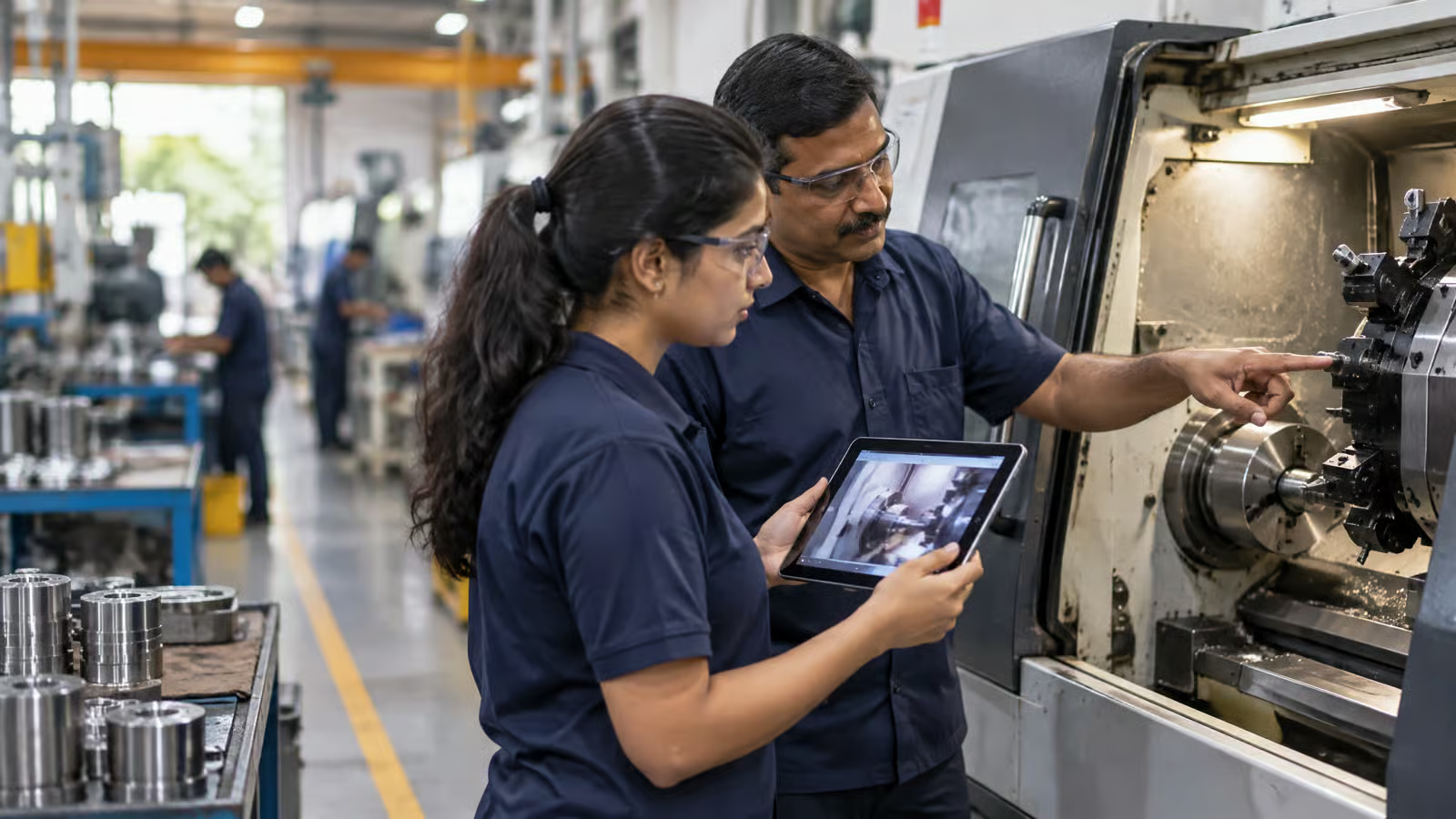
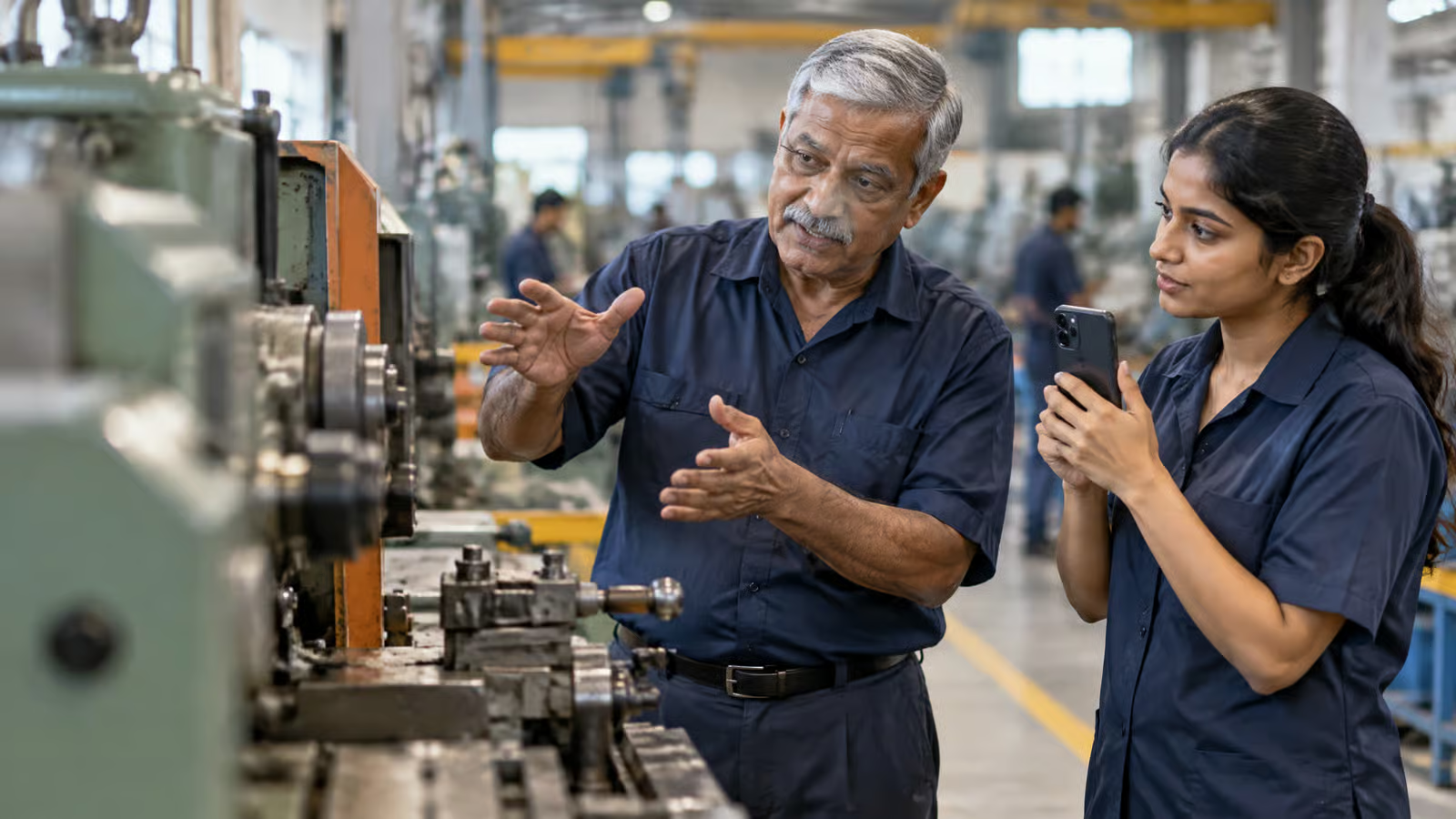
In most factories, AI does not replace office staff. It replaces the repeated tasks inside their jobs, such as typing the same details, searching for files and chasing updates. People keep the work that needs judgement, relationships and experience. The usual result is that the same team handles more orders, rather than a smaller team doing the same work.
Will AI take manufacturing jobs?
AI will change manufacturing jobs more than it removes them, especially in the factory office. The work that goes first is the most repetitive: retyping, copying between documents, searching for files and sending the same reminder again and again.
It is worth being honest about the edges. A role that is almost 100% data entry, such as a person who only types purchase bills into Tally all day, will shrink as AI reads and prepares those entries. But very few people in a small or medium factory do only one repeated task. The accounts executive who enters bills also reconciles with suppliers, handles queries and prepares for the CA's visit. AI removes the first part and leaves more time for the rest.
For a growing factory, the effect usually shows up in hiring. When orders rise, the owner does not need to add a second dispatch clerk or another accounts assistant just to keep up with paperwork.
Which tasks does AI take over in a factory office?
AI takes over tasks that repeat, follow clear rules and involve reading, typing, checking or reminding. Here is how that looks role by role.
Role | Tasks AI can take over | Work that stays with the person |
|---|---|---|
Sales coordinator | Logging enquiries, drafting quotations, follow-up reminders | Understanding the customer, negotiating, handling special requests |
Dispatch executive | Typing invoice, e-way bill, packing list and challan details, cross-checking them | Planning loads, dealing with transporters, solving problems at the gate |
Accounts executive | Entering vendor bills, sending payment reminders, tracking deadlines | Reconciliations, supplier and customer disputes, working with the CA |
Quality executive | Filing records, chasing signatures, calibration reminders, preparing audit packs | Inspections, root cause analysis, facing auditors and customers |
Production supervisor | Writing registers, typing end-of-shift reports | Running the floor, solving breakdowns, managing people |
Purchase executive | Chasing suppliers on pending deliveries, reorder alerts | Choosing suppliers, negotiating prices, managing quality issues |
The right-hand column is where experienced people add the most value. It is also the work that gets squeezed when their day is full of typing.
What work stays with people?
Work that needs judgement, relationships, responsibility or physical presence stays with people. AI cannot:
- Build trust with a customer over years, or calm one down after a rejected lot
- Decide whether a tolerance is achievable on your machines
- Negotiate a price or a delivery date
- Take responsibility for a quality decision, a signature or a statutory filing
- Walk the shop floor and notice that something is not right
- Handle the unusual case that no rule was written for
A well built automation also passes exceptions to a person instead of guessing. The more automation you have, the more valuable the people who handle exceptions become.
What actually changes in a normal working day?
The day shifts from preparing and chasing to checking and deciding. Take a dispatch executive handling 20 dispatches a day.
Example, before: Most of the morning goes into typing each order's details into the invoice, the e-way bill portal, the packing list and the challan. A wrong vehicle number is spotted only when the transporter calls from the checkpost. Test certificates are searched for in email while the truck waits at the gate.
Example, after: Each order's documents are prepared automatically and checked against each other. The executive reviews the set, fixes the one flagged mismatch and approves it. The time saved goes into planning loads, confirming delivery slots with customers and sorting out the day's real problems.
The job title is the same. The job is better. See how this works in our dispatch documentation automation.
Which roles grow when a factory adopts AI?
Roles that review, decide and improve grow in importance. Four stand out:
- The approver. Someone who knows the work well checks what AI prepares. Their experience becomes the quality gate.
- The process owner. The person who writes down the rules the AI follows: rates, formats, reminder schedules and approval limits.
- The customer-facing person. With less typing, sales and accounts staff have time to speak to customers instead of sending messages.
- The automation champion. One person who spots the next repeated task and works with the provider to automate it. This is often a younger team member who enjoys technology.
Long-serving staff often worry most, but their knowledge is exactly what an automation needs. The rate logic in a senior estimator's head, or the way an old accounts hand knows which customer pays after two reminders, becomes the rules the system follows. That makes them more valuable, not less.
Should you hire more staff or automate?
Hire when the work needs judgement, relationships or a new capability. Automate when the work is repeated volume that grows with your orders.
Situation | Better choice |
|---|---|
Orders are growing and paperwork is growing with them | Automate the paperwork |
You need someone to build relationships with new customers | Hire |
Your quality team spends days before every audit searching for records | Automate record keeping |
You need a skilled quality engineer for a new customer's requirements | Hire |
One experienced person is the only one who knows the rates | Both: capture their rules in an automation, and train a second person |
For a side-by-side view, read our comparison of AI automation vs hiring more staff.
How do you introduce AI without worrying your team?
Tell your team early, involve the people who do the work, start with a task they dislike and show them what happens to the time saved. How you introduce AI matters as much as which AI you choose.
- Say it plainly and early. Explain why you are doing it and what it means for jobs. Silence creates rumours.
- Involve the people who do the task. They know the exceptions. Their input makes the automation better, and they feel ownership.
- Start with a task nobody enjoys. Retyping dispatch details or chasing payments are good choices. Early wins build trust.
- Keep people in control. Make it clear that AI prepares and people approve.
- Train properly. Short sessions and videos, not a manual. Most automations work through WhatsApp and email, so training is light.
- Share the results. Show the hours saved and agree together what that time will be used for.
For longer-term upskilling, the government's Skill India Digital Hub lists free and paid courses, including digital skills. The Ministry of MSME also runs technology centres that offer training for manufacturing staff.
At Osvik, training and support are part of every setup, and one person from our team stays your contact after go-live. You can see the steps on our how it works page.
Make AI your team's assistant, not its replacement
Pick one task your team finds tedious, talk to the people who do it and ask what they would do with the time back. That conversation is the best starting point for any AI project, and it keeps your team on your side.
If you want help choosing that first task, book a free call. If a task repeats in your factory, tell us about it. For more on what AI can take over, see 25 AI use cases in manufacturing and what ChatGPT can and cannot do for factory paperwork.
Frequently asked questions
Will AI replace data entry jobs?
AI will reduce pure data entry work, because it can read documents and prepare entries automatically. Roles that are only data entry will shrink over time. Most factory office roles mix data entry with checking, coordination and problem solving, so people usually move toward reviewing and handling exceptions.
Will AI replace accountants in manufacturing companies?
No. AI can enter vendor bills, send payment reminders and track deadlines, but accountants still reconcile accounts, resolve disputes, interpret rules and work with the CA. Responsibility for filings and financial decisions stays with people. AI mainly removes the routine entry work around the job.
Will AI replace factory workers on the shop floor?
The AI automation discussed here works on office and reporting tasks, not physical production. Shop floor jobs are more affected by machines and robotics, which are separate investments. For supervisors, AI mostly removes register writing and report typing, leaving more time to run the floor.
How should I tell my team we are using AI?
Tell them early and plainly: which task you are automating, why, and what it means for their roles. Involve the people who do the task in setting it up, start with work they dislike, keep human approval, and share the time saved and how it will be used.
What skills will factory office staff need with AI?
The most useful skills are checking and approving AI output carefully, writing down clear rules for how work is done, handling exceptions, and basic comfort with tools like Excel, email and WhatsApp. Communication with customers and suppliers becomes more important as typing work reduces.
Can AI help me reduce staff costs?
It can reduce the cost of repeated work, mainly by letting you grow without adding back office staff for paperwork. Using AI mainly to cut existing staff often backfires, because you lose the experience that makes the automation work. Most owners get more value by redirecting time to sales, quality and customers.
Want this for your factory?
A free 30-minute call. Bring one real enquiry, sheet or report.